


Information for passengers
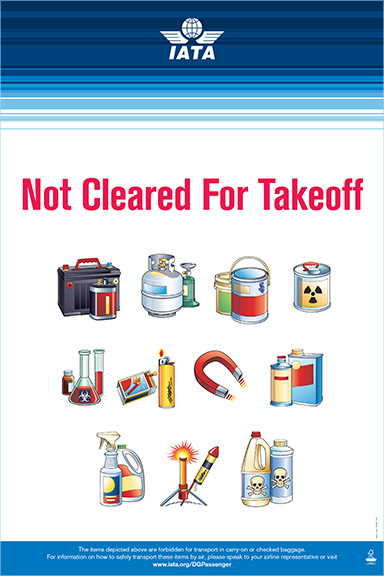
Dangerous goods are materials and objects which may cause significant risk for health, safety, material goods and environment. Dangerous goods are forbidden for transport in checked-in and hand baggage.
Hold Baggage
Baggage checked at the time of registration, transported in the aircraft baggage hold.
Hold Baggage Restrictions
Airlines determine the quantity, weight and dimensions of baggage transported free of charge. Any excess is subject to an additional charge.
- explosives, including detonators, grenades, mines;
- gases: propane, butane;
- flammable liquids;
- flammable substances and materials, such as magnesium;
- radioactive substances;
- oxidizers and organic peroxides;
- poisonous and infectious substances;
- corrosive chemicals, including mercury;
- vehicle engine fuel supply system components when containing fuel.
The contents of this list are not complete and identify only categories of prohibited items that must be removed from the hold baggage.
When items defined as dangerous goods are discovered during security screening, dangerous goods regulations must be applied in accordance with internationally accepted packing regulations (Annex 18 – Safe Transport of Dangerous Goods by Air; Technical Instructions for the Safe Transport of Dangerous Goods by Air (Doc 9284)).
Dangerous Goods Regulations define the possibility of exceptions related to transport in hold baggage.
Hand Baggage
Baggage taken into the aircraft cabin. Airlines determine the weight and volume of hand baggage.
Categories of items forbidden onboard the aircraft, except in case of prescribed permission approved by relevant state bodies, are:
- firearms and other objects which may fire off projectiles and cause serious injuries;
- sharp / pointed objects with blades or sharpened points which can cause serious injuries;
- tools which may be used to cause serious injury or pose a threat to aircraft safety;
- blunt objects which can cause serious injuries when used to strike;
- explosives, flammable items and devices which can cause serious injuries or pose a threat to aircraft safety;
- chemicals and poisonous materials.
Passenger Warning
In order to protect air traffic passengers, the EU introduced a limit concerning the amount of liquids allowed in hand baggage in 2006. These protective measures are applied at all airports in the EU, Norway, Iceland and Switzerland, and are also mandatory at airports in the Republic of Croatia.
Liquids include: beverages, oils, perfumes, lotions, gels, mixtures of liquid and solid contents, and pressurised containers such as shaving foam, gels, deodorants, perfumes and other items of similar consistency.
Only liquids in individual packages of up to 100 ml or 100 g, placed in a transparent, resealable plastic bag, may be carried in hand baggage. Maximum bag capacity is 1 litre. The bag must be completely closed (see picture).
Passengers are still allowed to:
- carry liquids if they are packed in hold baggage;
- carry liquids in hand baggage for medical purposes or special dietary requirements (including baby food), with evidence upon request by the person in charge;
- if flying from any EU airport to destinations in the Republic of Croatia, on a direct flight or with transfer at another EU airport, carry liquids (drinks, perfumes, etc.) purchased in shops located after Boarding Pass Control and/or Security Check. Such liquids must be packed in a transparent plastic bag (STEB). In 2008, EC Regulation 820/2008 entered into force, allowing passengers travelling from Croatia and transferring at an EU or Switzerland airport to carry liquids onto aircraft again, provided they were purchased in airport duty-free shops after Security Check and Boarding Pass Control. This regulation applies to Dubrovnik, Split, Zadar, Rijeka, Pula and Zagreb airports. The permission is valid for goods purchased within 36 hours of transfer and packed in a sealed STEB bag, so that any attempt to open it affects the contents, which must remain visible.
Passenger and Hand Baggage Security Check
At passenger and hand baggage security screening, the passenger is required to:
- declare all liquids;
- present laptops and other electronic devices separately (e.g. mobile phones, etc.);
- remove coat and/or jacket, which will be screened as a separate item.
If you have any additional questions, please contact your airline or travel agency.
Excess or Special Baggage
Please submit a request for excess or special baggage through your airline reservation system. The request will be confirmed according to airline limitations and availability and charged in accordance with the airline’s charging rules.